
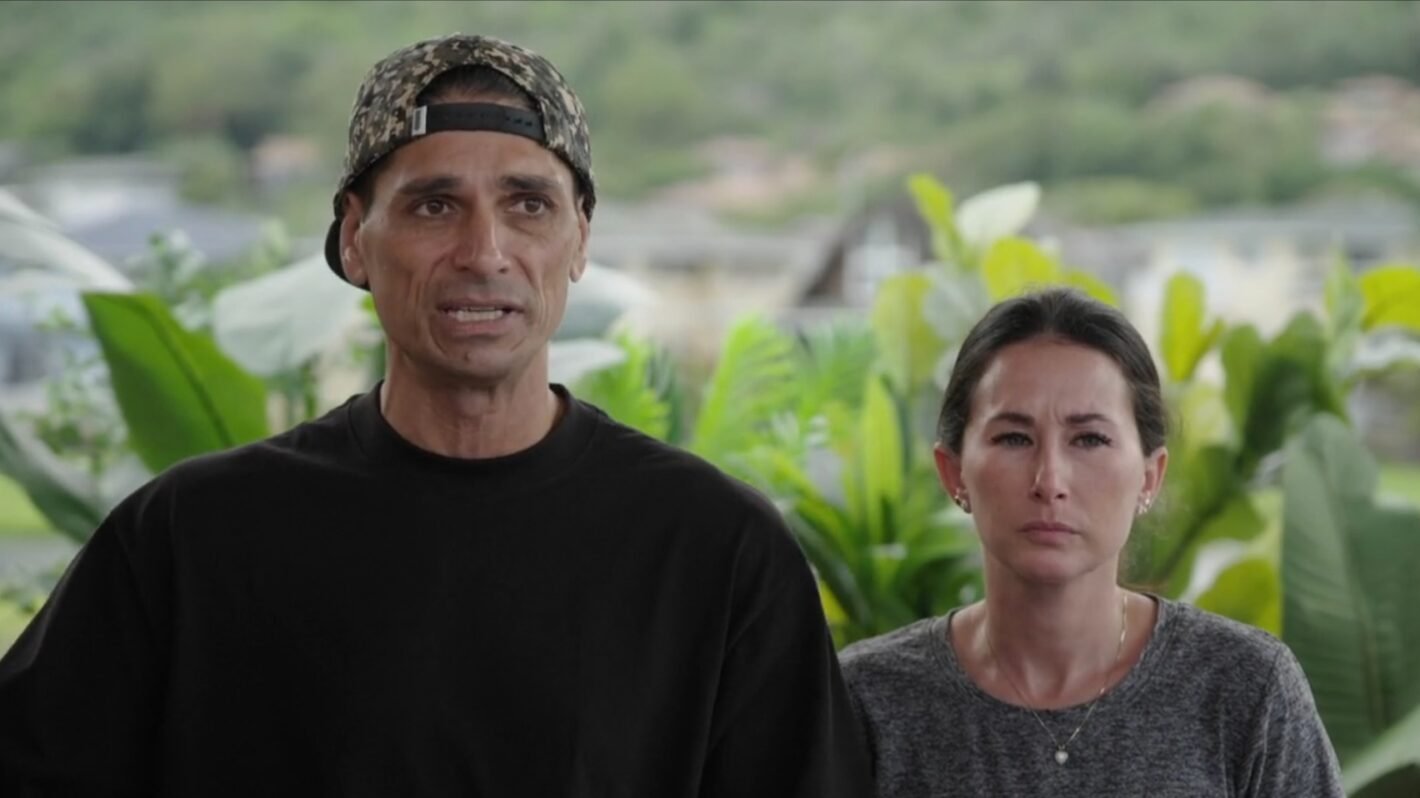
Kamohai and Tristyn Kalama built their television success by transforming neglected houses across Oʻahu into polished, profitable properties. But away from HGTV’s cameras, the married hosts of Renovation Aloha are facing renewed scrutiny over how some of their real estate holdings have been renovated and rented.
The couple now owes the City and County of Honolulu approximately $40,000 in fines connected to two properties that officials say were advertised as illegal short-term vacation rentals. According to the Honolulu Department of Planning and Permitting, none of the penalties had been paid as of early May 2026.

The latest enforcement action adds to a growing list of regulatory and legal problems involving the Kalamas, their development businesses and the production of their popular home-renovation series.
One of the properties is a waterfront home on Kamehameha Highway in Kāneʻohe. The other is a residential house on Waimakua Drive in Mililani. City investigators determined that both had been marketed for stays that were shorter than local law permits.
The Kāneʻohe property received a $10,000 fine, while the Mililani property accumulated approximately $30,000 in penalties. The Mililani home has also reportedly been connected to a $10,000 tax lien.
Oʻahu’s Strict Vacation-Rental Rules
Short-term rentals have long been a controversial issue on Oʻahu, where officials have attempted to balance tourism with the needs of permanent residents.
Under Honolulu’s regulations, rentals lasting fewer than 30 consecutive days are generally allowed only in designated resort districts or at properties that have received the necessary authorization. In most residential neighborhoods, a home cannot legally be rented for fewer than 30 days without a valid permit.
The rules are intended to prevent residential housing from being quietly converted into vacation accommodations. Supporters of the restrictions argue that illegal rentals can reduce the number of homes available to local families, increase housing costs and create disruptions in otherwise quiet neighborhoods.
City investigators say the Kalamas’ properties did not meet those requirements.
The Kāneʻohe home, which was associated with the couple’s company and listed under Tristyn Kalama’s name, was advertised as a high-end waterfront retreat. The four-bedroom, two-bathroom property reportedly offered ocean views and was available for a minimum stay of only three nights.
The advertised price was approximately $1,000 per night.
An investigation conducted by the Department of Planning and Permitting at the end of January determined that the property was being offered as a short-term rental without the required permit. That finding led to a $10,000 fine.
The listing was still visible on Airbnb in early May and continued to show a three-night minimum. However, after reporters contacted the Kalamas seeking comment, the conditions of the listing were changed to require a 30-day stay.
That modification would bring the advertised rental period closer to Honolulu’s minimum-stay requirements, but it did not eliminate the penalty that had already been issued.
Kāneʻohe Home Also Has an Active Building Violation
The vacation-rental investigation is not the only city enforcement matter involving the waterfront property.
In January 2025, Honolulu officials issued a notice alleging that construction work had been performed without the necessary building authorization. That original notice was later canceled after ownership of the property was transferred from Stand Firm Development LLC to Tristyn Kalama personally.
The change in ownership did not resolve the underlying construction concerns.
A new violation notice was issued in June 2025, and the matter remained active in May 2026. City officials said no permit application had been submitted to correct the alleged violation.
Department spokesperson Davis Pitner said inspectors were preparing to visit the property and personally deliver the notice.

The unresolved building issue is especially significant because it follows earlier reporting about the pace at which homes featured on Renovation Aloha were renovated.
The television series presents the Kalamas purchasing distressed or outdated properties, completing extensive renovations and reselling the homes. The transformations are edited into fast-moving episodes that emphasize design problems, construction deadlines and potential profits.
However, an investigation into the show’s first season found that work on several properties had begun before Honolulu approved the relevant permits.
Eight homes from the show’s first season were reportedly affected.
Starting construction without final authorization can create risks beyond fines for the developer. Future owners may inherit unresolved violations, face difficulties obtaining insurance or financing, or become responsible for fixing work that does not meet local building standards.
At one property, concerns reportedly included cracks in exterior concrete large enough for daylight to pass through.
The Kalamas ultimately paid about $20,000 in penalties connected to earlier violations. That amount was relatively small compared with the approximately $1.3 million in profits the couple said their real estate strategy had produced.
Mililani Property Accumulated $30,000 in Penalties
The second short-term-rental case involves a three-bedroom, two-bathroom home on Waimakua Drive in Mililani.
The property is partly owned through Stand Firm Developments, one of the Kalamas’ business entities. The remaining ownership is connected to an entity registered to Tristyn Kalama’s father.
City records indicate that the home accumulated approximately $30,000 in fines for allegedly being operated as a vacation rental without proper authorization. The first penalty reportedly dates to July 28, 2025.
Although the home was no longer advertised on Airbnb by May 2026, it later appeared on Zillow as a longer-term rental priced at approximately $6,000 per month.
The Zillow profile was active as recently as May 5. By the following day, after reporters contacted the Kalamas, the rental information had been removed or modified.
The listing had reportedly been taken down and restored several times during the previous year.
Changing or removing an advertisement does not automatically resolve previously issued penalties. According to the planning department, the fines connected to both the Kāneʻohe and Mililani properties remained unpaid.
Requests for comment were sent to the Kalamas through their company email address and to Tristyn personally. No response was received before the original story was published.
The timing of the listing changes nevertheless attracted attention because both properties were updated soon after questions were sent to the couple.
Another Renovation Produced a $2,800 Penalty
The Kalamas have continued acquiring and renovating houses while dealing with the outstanding disputes.
Another project on ʻIliʻāina Street in Kailua is owned by Kamohai and Tristyn together with Tristyn’s parents. That property was cited for a building-permit violation in December.
Unlike the unresolved cases involving the other homes, the owners eventually corrected the permit issue and paid a $2,800 penalty, according to the city.
The Kailua case illustrates that the problems surrounding the couple are not limited to vacation-rental regulations. Questions have repeatedly emerged about whether construction began before the appropriate approvals were in place or exceeded the work authorized under existing permits.
For local residents, the concern extends beyond paperwork.
Mo Radke, chair of the Kāneʻohe Neighborhood Board, said he had not previously known about the Kalamas’ rental listings. Speaking more broadly about illegal vacation rentals, he argued that property owners must consider how their business decisions affect the people living nearby.
When owners ignore regulations for their own financial benefit, he said, it creates an unfair situation for residents and for other property owners who follow the law.
Illegal short-term rentals can bring a regular flow of temporary visitors into residential streets that were not designed to function like hotel districts. Neighbors may experience additional traffic, noise, parking problems and uncertainty about who is occupying nearby homes.
Critics also argue that allowing unauthorized vacation rentals to continue can encourage other owners to disregard the rules.
Success Continues Despite Growing Controversy
The enforcement issues have not stopped the Kalamas’ television career.
Renovation Aloha has continued to attract viewers with its combination of Hawaiian scenery, family dynamics and dramatic home transformations. Promotional materials for the show’s third season promised some of the couple’s most difficult projects yet, including homes affected by rats, squatters and unexpected discoveries beneath the ground.
The season began airing March 21, 2026.
One of those discoveries, however, led to a far more serious controversy than an ordinary renovation surprise.
During work at one property, ancestral Native Hawaiian remains—known as iwi kūpuna—were discovered. Footage involving the remains was reportedly recorded for the television production.
Hawaiʻi law places strict protections around ancestral burial sites and human remains. Filming iwi kūpuna without permission from the appropriate state burial council can violate those protections.
The Hawaiʻi Attorney General’s Office obtained a temporary restraining order against Warner Bros. Discovery, HGTV’s parent company, to prevent the footage from being broadcast.
The restriction was later lifted after the company agreed that the material would not be included in the third season of Renovation Aloha.
The incident deepened criticism surrounding the show and raised questions about how entertainment productions handle culturally sensitive discoveries. What may have initially been framed as a dramatic television moment became a legal matter involving Native Hawaiian history, burial protections and respect for ancestral remains.
A Growing Divide Between Television and Reality
On television, the Kalamas’ projects are presented as ambitious efforts to rescue deteriorating homes and return them to the market. Their personalities, family story and willingness to tackle difficult properties have helped make them recognizable figures in the home-renovation world.
Behind the finished kitchens, landscaped yards and profitable sales, however, city records reveal a more complicated operation.
The couple has faced accusations involving construction that began before permits were approved, work that allegedly exceeded authorized plans, illegal vacation-rental listings and unpaid municipal fines. Their production has also encountered legal action over the handling of Native Hawaiian remains.
The $40,000 in short-term-rental penalties represents the latest chapter in that pattern.
As of the city’s most recent statement, the fines had not been paid. The Kāneʻohe home still had an active building violation, and officials said no application had been filed to bring the disputed work into compliance.
The Kalamas had not publicly addressed the latest allegations when the matter was reported.
For now, Renovation Aloha continues to present the couple’s property transformations to a national audience. But in Honolulu, their real estate activities are receiving attention for reasons that extend well beyond television ratings, design choices and renovation profits.
